The Real Human Cost of our Current EM System
Let’s talk about the practical numbers — the real human cost — that our current emergency management system requires in disaster.
In our current system, each level of government opens an emergency operations center (EOC) and invites in everyone working on the disaster. In an emergency, when the event stays within the boundary lines of one jurisdiction, this is a great opportunity to get everyone on the same page and working together. But as it extends beyond those lines, the utility of an EOC declines rapidly — and, I’d argue, lowers the capacity for the entire enterprise to provide services directly to people. Last-mile response.
A frequent role I played at the Red Cross was managing all the liaisons to other entities — government, private sector, and VOADs. We measured success by maintaining liaisons to all activated EOCs in a disaster area. I worked with all of them to make sure liaisons were informed and aligned with the decisions coming out of our Red Cross operations center, making sure they were in any meetings that impacted our work, keeping up with reporting requirements, and finding coordination wherever we could.
I remember the moment the sheer scale of it all hit me. It was Hurricane Matthew in 2016. With impacts across four or five states, the number of EOCs that were open was hard to keep track of — county EOCs, city EOCs, state EOCs, federal. Each one a silo taking on their portion of the disaster.
And that’s the fundamental tension. As the disaster expands beyond their boundaries, each EOC is only seeing one slice. They are responsible for their jurisdiction and advocating for their piece. But organizations like the Red Cross, the Salvation Army, utilities, and private sector companies are working the entire disaster. They have to manage limited resources across every impacted community — not just the one in the room. And every EOC in the disaster is making the same case: we need more. Without anyone looking at the full picture and making sure resources flow to where they are most needed, the system doesn’t coordinate — it competes.
At Red Cross, since relationships with government were often contentious or on the verge of it, we needed experienced leaders who could find ways to insert themselves into the conversation. EOC leaders often wanted decision-makers for elements in their small part of the disaster, but we needed to maintain overall management across the entire event because resources are always limited. Naturally, every jurisdiction wanted to advocate for the best and most for their community. So our liaisons often had to find polite and yes-sounding ways to say no to exorbitant resource requests — or we found ourselves negotiating, even playing middleman between conflicts with other entities — between state and county, state and tribal, state and federal, including territories.
That meant we needed high-level leaders in those EOCs. Many of them were qualified, experienced, and trained to support high-level work in the field. They could manage large shelters, large-scale feeding operations, distribution of emergency supplies, or an entire area command. By keeping these leaders in EOCs, we were significantly reducing our capacity to serve survivors. During Hurricane Matthew, I went through the qualification level of each of our liaisons and calculated how much larger of a shelter population we could support if even a small fraction were able to work in the field. The number was in the thousands.
There are real costs to maintaining this structure in disasters — especially disasters that cross state lines.
At one point, FEMA started sending a voluntary agency liaison over to the Red Cross operations, which was very helpful. But we continued to have our liaisons over at FEMA. We had liaisons in the National Response Coordination Center, in the Regional Response Coordination Center, often multiple in the Joint Field Office, including one tied into the National Incident Management Team. In theory, these were the same two organizations — Red Cross and FEMA — needing liaisons between each other at every physical location where they were working.
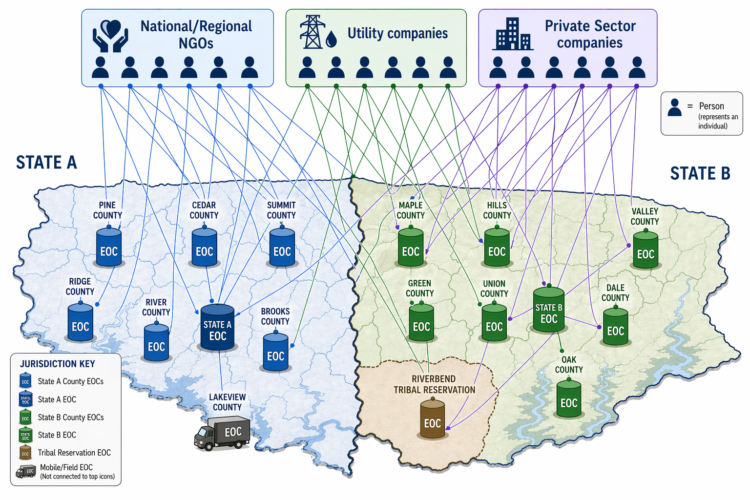
And it wasn’t just Red Cross. Don’t even get me started on the hostage exchange of liaisons between FEMA and the states and territories. Or between the state and the counties, the state and tribal nations, the counties and the cities. Every pair of organizations that needed to coordinate was swapping people back and forth across every physical location in the disaster.
This is what DALL-E produced on my first attempt at the prompt, which really expressed the chaos:
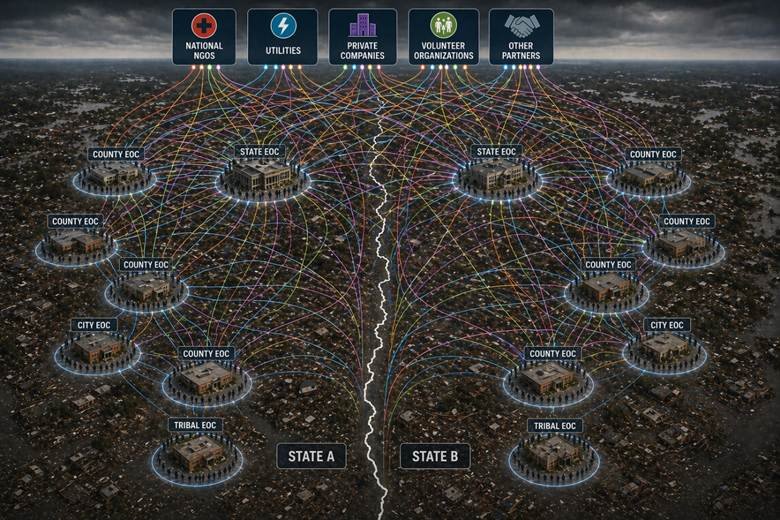
And it’s not just the cost. It’s the ineffectiveness. The more liaisons you spread across more EOCs at more levels of government, the harder coordination actually becomes. Each liaison is embedded in a silo that sees only its portion of the disaster and is incentivized to advocate for more resources for that portion. Few, if any, in this structure maintain the role of looking across the whole event and asking: where is the need greatest? Where are resources being duplicated? Where are gaps forming that no single EOC can see? The liaison system doesn’t answer those questions. It makes them harder to ask.
Think about what we’re actually doing here. With all the technology available to us — shared platforms, real-time data, communication tools that didn’t exist a decade ago — the primary coordination mechanism in American disaster management is still putting a person in a room. The most analog, most expensive, least scalable form of communication there is. Every EOC is essentially saying: I need a human body from your organization sitting in my building for twelve hours so we can talk.
And this isn’t just my experience. A recent NEMA Private Sector Committee white paper documents the private sector’s frustration with the lack of coordination and collaboration in disaster management. Their solution is more liaisons — more presence in the room. And I understand why. In the current system, if you’re not in the room, you don’t exist. Government moves around you, working with the resources they can control, because that’s the action the system incentivizes. But I think that’s the wrong answer to the right question. The question isn’t how do we get more people into more EOCs. It’s why do we need to be in the room at all to coordinate.
A big part of the problem is that there is no coordination function within those EOCs. The intention is collaboration in theory. In practice, incident action planning is not about coordination at that scale. Incident support models may have a structure for coordination, but they don’t have a function to do it. Even when there are taskforces, they are not integrated into the overall system. (Much more on this in future posts and in my book.)
At the risk of being too millennial, this is “a meeting that could have been an email” at disaster scale. We are prioritizing bureaucracy over service to people. Command and control over coordination.
As we must always remember, these nongovernmental entities are the true foundation of disaster response — they always have been. Utilities, nonprofits, private companies, community organizations — they are generally not under the direction of government. They work independently, but with limited resources there is an absolute need to coordinate. Instead, the current system asks them to pour their capacity into supporting government structures rather than serving survivors.
And it’s not just them that are hurt by this system.
Look at the first image again. See Lakeview County at the bottom of State A?
No lines. No coordination web. Just a truck. That’s a rural county with a part-time or volunteer emergency manager who jumps in a vehicle to organize their community’s piece of the disaster. They’re in the disaster, but they’re not in the system. They don’t get the liaisons. They don’t get the coordination. They don’t get access to the same information. The structure doesn’t just disadvantage them — it makes them invisible to the organizations that could help.
The instinct is to say the answer is to equip them with their own EOC. But that’s treating the symptom. Why would we ask a resource-strapped community to build and maintain one of the most resource-intensive structures in emergency management? Wouldn’t it make more sense to build a system that works for them in the first place?
The Wrong System for the Job
This is what happens when we keep thinking like firefighters. On an incident scene, the answer to a bigger fire is more people, more resources, more hoses pointed at the problem. And that works — for fires.
But disaster consequence management isn’t a fire. You can’t just add more people to put it out. The complexity isn’t about scale — it’s about interconnection. Dozens of independent organizations, hundreds of communities, thousands of decisions that ripple across jurisdictional lines. Pouring more liaisons into more EOCs doesn’t coordinate that complexity. It just makes the scaffolding heavier.
We don’t need more people holding this structure together. We need a different structure — one built for coordination, where shared information and transparent resource prioritization replace the need for everyone to be in the same room. Where the experienced people currently sitting in EOCs can go back to doing the work they were trained for. Where communities without a full EOC aren’t structurally invisible. Where we can leverage all our resources to best support the people we collectively serve.
No one emergency manager can make these changes. This is about system architecture — and whether the way we’ve organized disaster coordination is actually serving the people it’s supposed to serve, or consuming the very capacity they need to prop up a system that isn’t doing its job.