I’ve read so many of the responses to the new FEMA definition of emergency management, and I wanted to add my two cents.
In my opinion, the definition itself is heading in the right direction. The rest of the memo becomes a little contradictory to it. It’s still trying to do everything, and it combines a lot of terms in ways that don’t make sense under the true definition of the words. But that’s what happens in FEMA policy (and maybe all federal policymaking). Everyone gets an equal say and throws things on like a Christmas tree. Sometimes a light goes out halfway along the string, but we keep the rest of it on.
So here’s why I think the definition works.
Let emergency management be EMERGENCY management
I hear so many people pushing back against the idea that emergency management gets tangled up with emergency services, insisting that it does so much more, and that we have such a hard time differentiating ourselves from first responders.
Yet for 20-plus years, we’ve based the majority of emergency management on an emergency services organizational and planning model. Nearly all the tools and training included in accreditation are slightly modified first responder tools. As much as people advocate for a fuller, more in-depth profession, not much has changed to show that we are training or educating for one.
I rarely see an emergency management job description that goes beyond ICS courses as its desired proficiency. Those courses have nothing to do with the disaster cycle, with mitigation or long-term recovery. (I’ve written quite a bit about why ICS is not only inappropriate for disaster work off-scene, but can be harmful.)
The trainings, the certifications, the accreditations, and the job descriptions all tell the same story. Emergency management is focused on emergency services, and it is operational.
And there is growing, if scattered, evidence that what we’ve built for emergency management does not hold up in disasters.
So why are we fighting the definition?
Let’s be honest
I keep seeing reactions like “We have to do this other stuff. These things keep getting thrust upon us.” That certainly hasn’t been my experience. And it doesn’t tally with the advocacy for the profession.
There has been significant mission creep over the last 20 years, often driven by a command-and-control culture and by emergency management trying to gain more ground for funding and authority, in the name of making it a profession. We are pushing for more money, more people, and more authority without even a correlation to how that helps people and communities throughout the disaster cycle. I think we’ve lost sight of the purpose of all this.
Over the next couple of posts, and with much more storytelling in the Disaster Coordination Lab, I and others will share stories where that culture led to things like “I need to take this over because you aren’t doing it right,” or “You aren’t telling me what I need to do my job so I’m going to contract out instead of partnering,” or some variation. Through many stories, you may start to see the well-intentioned, but unhelpful and dangerous, pattern.
In my experience, people in and around this field want to do good, and I think many believe that expanding the command and control of emergency management will lead to good things. But I challenge you to review that logic. If we took the time to focus on outcomes for people and communities, the best actions might look different.
A lot of people dislike the definition because it doesn’t include the full cycle, which they say is what emergency managers have to do. But that’s arguing for the status quo because of the status quo.
We have an opportunity to make things better here.
Where the full cycle belongs
[IMAGE]
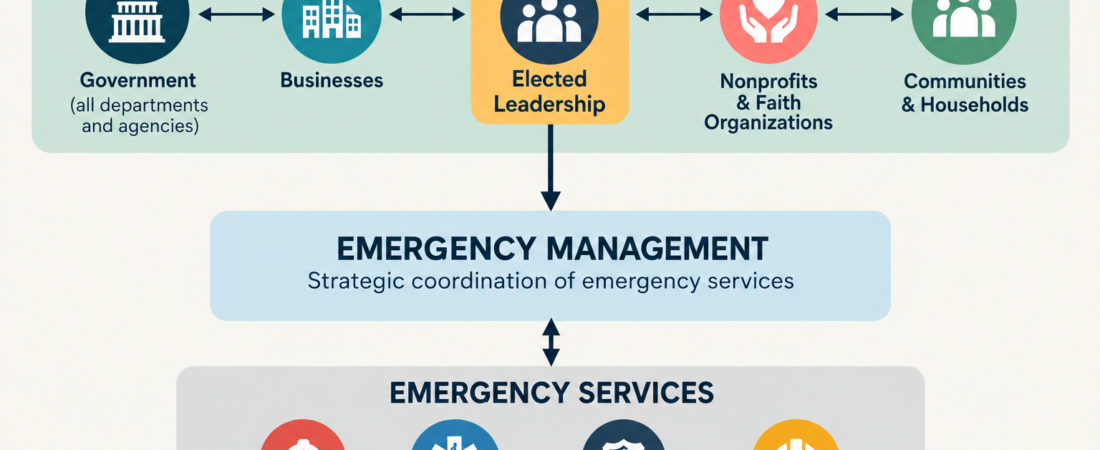
This works better than trying to collapse everything into a single emergency management definition. Mitigation, long-term recovery, and the full disaster cycle belong to disaster management. That lets us align with the terminology and research from around the world on disaster management, disaster risk reduction, disaster response, and disaster recovery. And it keeps the defining terms and definitions that have been the basis of disaster science for nearly a century.
And honestly, a lot of emergency managers don’t want to do the other stuff. These are very different competencies and very different styles of work. It’s a rare person who is really great at incident command and also at long-term recovery.
Letting them be separate would be good for emergency management, too. That’s even the problem with ICS. We keep changing it to fit all manner of disasters, and in the process we’re losing the main pieces that make it work well in operations.
The wrong tools for the job
We’ve been struggling so much because we are trying to do complex work that requires coordination with the tools and training of incident command. It’s like trying to do differential equations with an abacus. The formulas are different.
There is growing evidence, especially from the pandemic, that emergency managers have been stopping the use of more advanced and more appropriate tools and methods in favor of incident command. Mitigation, coordination, and long-term recovery all draw on fields with far more rigor, tested, evaluated, and improved over time: city planning, project management, disaster sociology. Instead of using them, we take over and use ICS, which wasn’t even built for emergency management. (For more on this, check out my published works.)
We have not done that kind of testing and improvement in emergency management. But it is starting to happen now. I have focused on bringing forward the decades of research showing that ICS and incident action planning are not being used appropriately. I’ve heard several people start to question the rigor of HSEEP (which you should). I imagine we can start looking at how overly basic CPG 101 is, how much of an amalgamation of intents and compromises the entire National Preparedness System is, how much we have decimated THIRA/SPR to make it easier, and so on.
There is plenty of evidence that we aren’t heading in the right direction…if your outcome is building sustainable, effective programs that help people and communities throughout the disaster cycle. And this isn’t just FEMA. It’s the heart and culture of this entire industry, field, profession, whatever we call it. At some point, just arguing for a name may be arguing for a lot of practices, programs, and systems that are found to be ineffective for the work.
If you are arguing for the status quo to continue and just get bigger, what outcome are you fighting for?
We were warned
And worse, we were warned. When we abandoned disaster management and disaster science for an operational incident command culture 20 years ago, researchers warned us, comprehensively, consistently, and adamantly, that exactly this would happen.
I’ve written about a lot of this, but I recently found a another example from Thomas Drabek. In The Human Side of Disaster (2010), writing about bureaucratic mindsets, he named a critical constraint: “the attitudes of emergency managers.” He described management styles that were “authoritarian, top-down, and exclusive rather than inclusive,” and warned that “at times it seems like we are returning to the autocratic mindset that defined many civil defense directors during the 1950s.” He called it counterproductive.
Then this:
“Too often, however, I have been told by some emergency managers that response effectiveness requires more trained staff, more hardware, more discipline.”
Sound familiar?
I challenge you to look at the advocacy for the profession, or even the recommendations in our AARs, and see how often they reflect that same unending push for more staff, more equipment, and more control.
So let’s reset. Let’s learn the lesson, possibly for the second time, that operational tools, systems, and culture alone (like in the civil defense era) will not work in disasters. Let’s get back to disaster basics. I’m not saying the FEMA memo completely does that. But the intent and the definition are a start.
Signs of the shift
I think we can already see signs of this shift in the naming conventions.
Long Beach, CA recently advertised for a Director of Disaster Preparedness and Emergency Communications, bringing multiple streams of disaster-related work together in a senior position reporting directly to the City Manager.
I’m not sure how long it has had that structure, but I think it is heading toward the future of the field.
Disaster management needs to sit high enough in an organization to see across the systems that will have to function together in a disaster, and to carry the executive’s coordinating responsibility, rather than sitting entirely within the emergency services portfolio. That’s a real alternative to endlessly enlarging the conventional emergency manager’s job. Move the disaster function up. Give it the scope to look across.
And maybe not every government needs a position called emergency manager. Maybe the work can sit in a first responder shop like the fire service. (Small, rural areas already spread this work across the people they can afford.) The work of disaster management, the whole cycle of preparedness, mitigation, response, and recovery, can be shared. We don’t have to command and control it all. We can work together toward outcomes.
Let emergency management be emergency management
We can keep fighting for a definition that never fit what we built. Or we can take this moment for what it is: an honest description of a profession that does important work, and an invitation to build the level above it.
Let emergency management be emergency management. Disaster management is everyone’s job. It’s time we organized around that concept.
[Sales Pitch warning] This is what I’m building for
That’s what the Disaster Coordination Lab is about.
It may take time for governments and funding to make this shift, and they will need something other than ICS to build around. So while my company is building, I also want to share the work and the ideas, and invite others to do the same. We will tell our stories honestly.
The Lab is independent and participant-led, with no need to align to a specific government. It’s a platform for brainstorming the new paradigm, at least for the U.S., aligned with the disaster research that’s already out there but not tied to particular systems or tools.
Think of it as a virtual conference that lasts all year, with different breakout rooms you can join at the same time. Or, if you are a developer or consulting company, think of the working groups, each attached to a mini-course, as an hour or so of expert consulting.
The courses are short, 30 to 90 minutes, and each has an associated community. Purchasing any course gives you entry to the wider Lab community as well as the topic-specific one. Each course includes open-ended questions, and participants’ answers are aggregated and shared with the community. Once we have full functionality up, planned for the start of 2027, we’ll start breaking down honestly what isn’t working, so the whole Lab can work toward solutions.
It’s an incubator for better outcomes in disasters, for anyone working in the disaster cycle. Which is everyone.
Leave a Reply