Shifting from Government-centric to Community-Centric
If the popularity and reactions to my post last week are any indication, the idea that individuals and communities impacted by disasters are the primary and majority responders in a disaster resonated.
So let’s follow that premise to its logical conclusion.
If individuals and communities have most of the work to do in a disaster, then the role of the wider response system has to shift too. At disaster scale, the system cannot take over all of that work, nor should we design it around the assumption that it can. Its job increasingly becomes enabling people and communities to do their work. By focusing on providing information, resources, specialized capabilities, and support, and filling the gaps they cannot fill themselves. The work of response systems is to enable individuals and communities to respond and recover.
When the Event Changes, the Operating Model Has to Change
First, remember the premise of this blog: disasters are different from emergencies.
A disaster isn’t defined by the size or intensity of the hazard alone. It is defined by what happens when that hazard significantly disrupts the social systems people depend on. A Category 5 hurricane spinning harmlessly over the ocean is an enormous hazard, but not a disaster. A relatively ordinary rainstorm hitting a small vulnerability in a dam or levee causing it to flood a nearby neighborhood is a disaster.
The hazard isn’t the disaster. The consequences for people are.
That distinction matters because an emergency and a disaster create different operating environments.
In an emergency, concentrating information, resources, authority, and expertise into a response organization makes sense. Someone calls an emergency line (like 911 in the US). Trained responders arrive. They assess the problem, establish control of the scene, make decisions, bring specialized resources to bear, and solve a problem most people do not have the capability or authority to solve themselves. We want firefighters taking control of a structure fire. We want paramedics making decisions at a medical emergency. We want law enforcement establishing a safe perimeter around a dangerous scene.
That model works because the response system has sufficient capacity relative to the problem.
A disaster changes that equation.
When needs become widespread, infrastructure is disrupted, communications are degraded, and many people need help simultaneously, the response system no longer has enough capacity to take over the work. People don’t stop responding while they wait for that capacity to return. They evacuate, find shelter, locate food and water, care for family members, share information, clear debris, move resources, reopen businesses, file insurance claims, begin repairs, and make thousands upon thousands of decisions about what happens next.
The operating model has changed whether we acknowledge it or not.
Our disaster management systems should change with it.
Government-Centric Versus Community-Centric
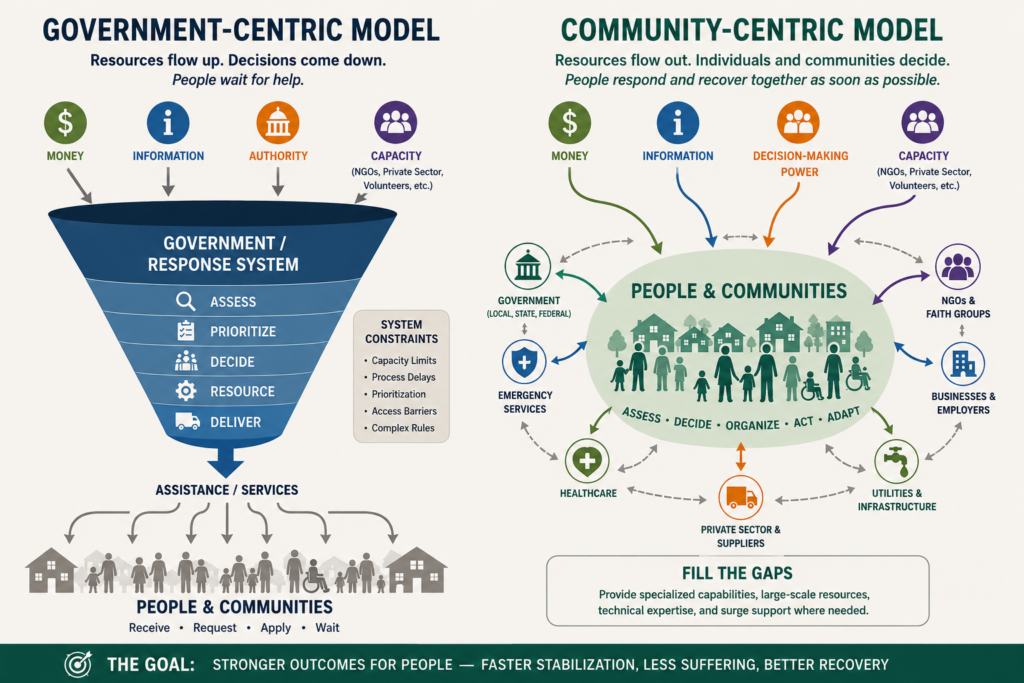
One way to think about that shift is the difference between a government-centric and a community-centric model.
In an emergency, pushing information, resources, and decision-making up into government systems produces better outcomes, because government has the capacity to fix the problem itself. That’s the whole logic of calling 911. Concentrate the problem into the hands of people equipped to solve it, and they solve it.
In a disaster, the equation changes. Government no longer has the capacity to fix everything itself, no matter how much information or authority flows up to it. Better outcomes come from sending information, decision-making authority, resources, and capacity back out, to the people and communities already doing the work. Fix the environment around them so they can keep doing it. Build a safety net under anyone who’s struggling to do it alone.
Community-centric doesn’t mean community-only. Government still has a role, but it’s a different one: enabling and filling gaps, rather than trying to be the place everything routes through. That’s working smarter, not harder. A system that leans into what people already do in a disaster, instead of fighting it, asks less of everyone, less strain trying to control something too big to control, less friction for people who were already going to act regardless.
This Is a Disaster Competency
None of this means abandoning the systems we use for emergencies. We need them, and they’re very good at what they were built for.
But at disaster scale, pouring in massive resources or standing up elaborate government programs doesn’t automatically produce better outcomes. Sometimes the more effective move is smaller: information that lets a family decide without waiting, a supply line that reaches an existing neighborhood network instead of building a new one, simply getting out of the way of people already solving their own problem.
Command and control, and the emergency response practices built around it, aren’t designed to find those moves. They’re built to manage a contained problem within a hierarchy, not to read and respond to the scale and complexity of a disaster. That takes a different kind of system, one built for coordination instead of command.
A Particular Challenge in the United States
This is where I think the United States has some work to do.
Over the last twenty five years, and especially through the major institutional changes of the early 2000s, we built our disaster management around the needs of emergency response. The country faced new threats, real interoperability problems, and pressure to get first responders talking to each other, organized under common structures, and working from standardized procedures. Those were the right things to fix at the time, for the on-scene problems the country was actually facing.
But fixing those problems meant building out command and control. And command and control has kept expanding since, becoming the default we reach for regardless of scale. Emergency-response concepts started shaping how we thought about disasters themselves. Command and control language got tangled up with disaster and coordination language. As those concepts moved from research and practice into doctrine, policy, and law, small transcription errors cemented into place. Order became the organizing concern, even though decades of research show how much effective cooperation shows up after disasters on its own. Government became the place we expected information, resources, and decisions to converge, whether the scale of the event called for that or not.
The result is that we built more emergency management, and less disaster management. We never made the strategic shift to coordination that disasters actually require. When an event crosses the threshold, our systems don’t change shape. They just get bigger, more command and control, applied at a scale it was never built for. And when the gaps show up anyway, our instinct is to propose a new law or a new program on top of the ones we already have, rather than go back and ask what actually caused the gap in the first place.
To be clear, this isn’t an argument against emergency management. We need those systems, and we need the people staffing them.
But we cannot meet a disaster by simply doing more of what we do for an emergency. More EOCs standing up across more jurisdictions, often duplicating each other’s work. More people brought in to manage the people and systems already managing the response. At some point, that’s no longer adding response capacity. It’s adding overhead and bureaucracy that compounds on itself, requiring still more resources to manage it.
As disasters get larger, our systems need to get more efficient, not more crowded. That means leaning harder on strategic coordination, and pushing information and resources out to communities and individual people. It means using the capacity that already exists there, rather than trying to build new capacity from government funding and authority every time. It also means building disaster literacy across the country, so people and communities are equipped to use that information and capacity well when it reaches them. We cannot keep depending on pulling trained personnel from across the country when the disasters we’re facing increasingly hit large parts of the country at once. There won’t always be a “rest of the country” to pull from.
This shift also isn’t something that happens once, at the moment a disaster hits. If people are the primary and majority responders, as we argued last week, that’s true across the whole disaster cycle, not just in the moment of impact. That means being honest, before disaster strikes, about the reality of what people can actually expect. Government will be overwhelmed. Services will be limited. That’s not a failure of will, it’s math at disaster scale, and pretending otherwise sets everyone up to be caught flat-footed when it happens. Facing that reality is what lets us say the rest of it plainly: here’s what you can expect from us, and here’s how we can work together to respond and recover.
That’s the strategic shift this moment calls for. Not more emergency management stacked on top of itself, but a deliberate move from government-centric to community-centric the moment an event crosses from emergency into disaster.
Otherwise we are just using emergency-scale thinking for disaster-scale problems. To our peril.
What’s Next
If our system has become government-centric, that should show up in the ordinary tools we use to run it. What we track. What we plan for. What we call success afterward.
The next few posts go looking for it and flag those transcription errors we’ve built into trainings, laws, policies, and the general knowledge of disasters. Here’s some upcoming headlines to give you a sense of the direction:
What if we treated emergencies like disasters?
IAPs mean OBEs
AARs = All the Feels
None of these practices are wrong on their own. Smart people built each of them to solve real problems, and I’ve used all of them myself. But together, they may show us where the center of gravity actually is and how that tilts our work away from the people we’re ultimately trying to help.
If individuals and communities do most of the preparing, responding, and recovering, then our disaster systems should be designed around making that work easier, faster, safer, and more effective.
The goal isn’t to build a response system capable of doing everything. It’s to build one capable of helping everyone do what they can and filling the gaps where they can’t.

Leave a Reply