The Problem with the Whole Community Approach
Over the past few weeks, I’ve written about discouraging community donations, telling trained volunteers to wait for instructions, and watching experienced NGOs slow themselves down waiting for command.
Each example looks different on the surface. But they point to the same underlying issue: how we’ve come to define the role of government versus the “Whole Community”.
What Whole Community Is
Most reading this are probably familiar with the framework, but let’s get on the same page. FEMA introduced the Whole Community approach in 2011. It was presented as “a philosophical approach on how to think about conducting emergency management.”
Whole Community is defined as “a means by which residents, emergency management practitioners, organizational and community leaders, and government officials can collectively understand and assess the needs of their respective communities and determine the best ways to organize and strengthen their assets, capacities, and interests. By doing so, a more effective path to societal security and resilience is built.”
An admirable philosophy that presents itself as an all-hands-on-deck approach needed for managing disaster. But there were dire flaws in how people reacted to it and what it was reacting to. Mistakes we’ve made before.
The Token Whole Community Role
Let’s acknowledge some of the minor issues that reflect how something like this would be implemented. As wholesome as it started, the term Whole Community became the punchline for many jokes in our field. As a Red Crosser, I frequently filled the token Whole Community role in meetings, trainings, and exercises. A couple times I got a table tent that just said “Whole Community”- no name, no organization. One time I was filling in at a local THIRA meeting and was expected to answer the questions for all parts of Whole Community – assessing staff and stuff for all things not government. Us versus them, which was especially weird since Red Cross is often both. Just by my showing up, they got to check a lot of boxes without really filling them.
This is an implementation issue, but not really the main problem with Whole Community.
The Real Problem
The real problem is the assumption that the Whole Community – individuals, businesses, NGOs – is surge support to the government. When words like “commandeering” get thrown around casually.
The Whole Community document itself leans into this by talking about the “pooling of efforts and resources” in times of resource constraint. It uses community policing as a prime example of Whole Community implementation – police utilizing community members to extend their reach. It describes police using coordination meetings to crowdsource helicopters from businesses to support a murder investigation. It’s a very first responder-oriented vision, which can be valuable in emergencies, maybe even whole nation catastrophes, but it runs counter to our natural behavior and culture in disasters.
Even disaster researchers lean into this conception by labeling people “spontaneous volunteers”. I understand that the original meaning was volunteering for the disaster response effort. Samuel Prince in 1917 writing about people streaming in from neighboring towns who “could not be expected to understand the nature of scientific relief services.” It makes sense if we are talking about people going to government or NGOs saying ‘Put me in Coach’, but more often these days, they are people, groups or not, that are stepping in to help their friends, family, neighbors, and community without asking for permission or requiring direction. Sometimes they organize themselves in Cajun Navy, Occupy Sandy, the boaters after 9/11 evacuating people. These aren’t volunteers doing the government’s job, they are community responders doing their own job. Similar to a bank customer making a deposit, supporting the bank owner’s job of getting money into the bank doesn’t mean that the customer works for the bank.
The Fundamental Inversion
In reality, the Whole Community does not work for government. The government works for the Whole Community.
In a democratic society, government exists to serve collective needs that individuals and private organizations cannot meet alone – providing infrastructure, exercising authority on behalf of the public, filling gaps where markets and voluntary efforts cannot or should not fill. That’s a mandate to support and enable, not to command and direct. Even in disaster, those limits of authority were built into the nation’s foundation.
Seen in a longer view, it’s striking how much this has shifted. Barely fifty years ago, the modern emergency management system was layered on top of citizens, businesses, and NGOs that had already been doing disaster response in this country for two centuries. Now, we have the government saying that when we’re overwhelmed, we’ll commandeer your resources and direct your operations.
That inversion runs counter to American norms and culture, and it’s a lesson we’ve learned before.
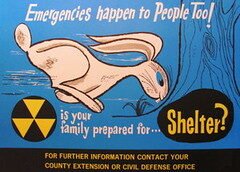
The Civil Defense Era
That mentality harkens back to the civil defense era of the Cold War. Much of civil defense planning centered on how to protect the population in the event of a nuclear attack. Many plans envisioned a build‑up period before an attack, when the government could move civilians out of target areas and into shelters or bunkers presumed safe from the blast.
Civil defense suffered from the same contradiction we face today. One school of thought imagined a vast government mobilization — a near‑police state — directing civilian life, relocating people, constructing shelters, laying evacuation routes, and deputizing wardens to enforce compliance. The other took a self‑help approach, assuming government would be crippled. It emphasized survival manuals, backyard shelters, Duck‑and‑Cover drills, warning systems, and household stockpiles.
When civil defense eventually collapsed into the growing disaster preparedness system, reviews showed that the centralized command model never took hold. It was too expensive, too bureaucratic, and couldn’t convince enough citizens to participate. The self‑help model, on the other hand, embedded itself in our national culture — because it resonated with how Americans actually behave in crisis. Civil defense proved that trying to direct civilians through command structures is culturally unsustainable. Self‑help endures because it aligns with who we are.
(For deeper reading on this topic, I’ve included several references below and recommend reading as I’m taking a broad‑brush view here.)
Re-learning the Lesson
Amidst all the frustrating and concerning changes, we have an opportunity to step back and reexamine how we’ve built disaster management in this country. Instead of lamenting what we could achieve if only we had more funding, resources, or personnel, we should question the assumptions that shape the system itself.
Have we designed disaster response through a first‑responder lens — assuming government can cordon off the crisis and take control? Do we expect agencies to direct civilian action even when, by definition, they’re overwhelmed? Are we pushing away community capacity by trying to command it, operating from a paradigm that runs counter to our national culture?
If disaster management is to evolve, we must stop trying to direct the Whole Community and start trusting it. We have an opportunity to build back better and see if there is another way.
Coordination, not command.
Much of the historical framing in this post is informed by the following works:
- Roberts, Patrick S. Disasters and the American State: How Politicians, Bureaucrats, and the Public Prepare for the Unexpected. Cambridge University Press, 2013.
- Rubin, Claire B., ed. Emergency Management: The American Experience, 1900–2010. 2nd ed., CRC Press, 2012.
- Clarke, Lee. Mission Improbable: Using Fantasy Documents to Tame Disaster. University of Chicago Press, 1999.
Leave a Reply