Beta is now Live!
Disaster Coordination Lab
Enroll Here – Disaster Coordination Lab.
**Join now for First Adopter discounts**
Learn More:
The Disaster Coordination Lab is a learning and collaboration space for people working to improve how disasters are understood, managed, and coordinated.
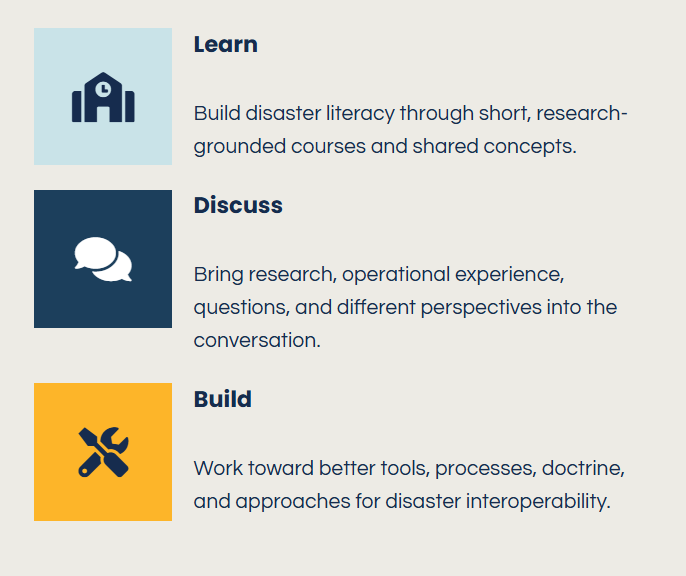
Courses provide a shared foundation in disaster science from a practical viewpoint. Community spaces and Working Groups create room to compare experience, challenge assumptions, work through practical problems, and build better policies, programs, tools, and practices.
Why the Lab
Understand Before We Build
Disaster management systems are often designed around procedures, organizations, and existing doctrine before we fully understand the problems they are supposed to solve.
The Lab starts somewhere else: with the research and real experiences.
Decades of disaster science tell us a great deal about how people behave, how communities respond, how organizations emerge and adapt, how information moves, and what happens when normal systems are disrupted.
The goal is to make that knowledge more accessible—and more useful to the people building the policies, programs, technologies, standards, and systems intended to work in disasters.
Independent Beta
The Disaster Coordination Lab is independently funded and intentionally lean during its Beta through December 31, 2027. That allows us to avoid falling back into the same policies and procedures or funder requirements of any one government, institution, or even existing doctrine. Participation helps fund the Lab itself and gives us room to question assumptions, follow the research, and focus on what is useful to serve people and communities impacted by disaster.
The courses are simple by design: accessible presentations of disaster research using stories, visuals, and practical examples rather than highly produced training. Language and visuals are similar to the Disasters are Different blog. During the Beta, the emphasis is on the quality of the ideas, the science, and the conversation — and on improving all three as people participate.
Want to see the style before joining? Check out the free preview of the public-facing course Everyone Responds in a Disaster.
Much of the foundational learning is intentionally shared between the public course and the professional Lab courses. Building better disaster management requires some common understanding between professionals and the people and communities who do so much of the actual work when disaster happens. Interoperability starts with shared disaster literacy.
Here’s What’s in the Lab
The Courses:
Current courses include:
- Disaster Fundamentals & Orientation
- People in Disasters: Fundamentals
- Communities in Disasters: Fundamentals
- Disaster Fundamentals Bundle
Additional courses are already listed as Coming Soon, with more planned throughout the Beta.
Disaster Science, Made Practical
The courses translate disaster research into accessible language, stories, analogies, visuals, and practical application.
They are designed to give participants the disaster science many of us wish we had been taught before we started developing plans, policies, programs, standards, technologies, and response systems.
Topics include:
- What makes a disaster different from an everyday emergency
- Human behavior, decision-making, and disaster myths
- Community response, social capital, emergence, and informal networks
- Disaster organization and coordination
- Strategic disaster coordination
- U.S. disaster-management policy
- Rethinking preparedness
- Additional applied topics developed throughout the Beta
The courses are not intended to be the end of the conversation. They are the shared starting point for it.
Community
Courses + Conversation
Every course purchase includes access to the broader Disaster Coordination Lab community.
Individual courses also include focused spaces where participants can discuss the research, respond to questions, share experience, challenge assumptions, and work through the implications for their own work.
Throughout the courses, participants will also encounter open-ended questions and opportunities to contribute perspectives that can be brought back into the larger discussion.
The goal is to create a place where research and practical experience continuously inform one another.
Working Groups
Working Groups are focused spaces for people who want to go deeper into specific disaster-management problems.
Rather than simply discussing a topic, Working Groups are intended to explore practical needs, compare approaches, identify gaps, and begin developing or testing better ways of working.
Initial topics include areas such as:
- Disaster decision-making
- Shared information environments
- Strategic coordination tools
- Other focused problems identified through the Lab community
They may produce ideas, frameworks, prototypes, tools, or simply a much clearer understanding of the problem.