Your Emergency Management Training Is Not Enough for Disasters
I’ve been looking at PhD programs lately, which means I’ve spent a lot of time reading program descriptions, course catalogs, and the many ways universities define this field. It’s been illuminating, and not always in a good way.
Take one program I came across. It had “Disaster Management” in its name, and it described two of its tracks this way:
Emergency management: Develop the skills you need to prepare for, respond to and recover from disasters that affect the public sector.
Emergency services management: Build the qualities you need to be a leader and decision-maker in the emergency management field.
So emergency management does disasters, but emergency services management does emergency management?
I laughed, thinking it was a typo, but then I kept running into versions of it.
We have a disaster literacy problem. We have people developing disaster policy, building disaster programs, leading disaster operations, writing plans, advising governments, and designing the systems we will rely on in the next major disaster who have received extensive training in emergency management but surprisingly little education in disaster science. They may know ICS and NIMS. They may have taken the full ICS sequence. They may know how resources are requested, how plans are written, and how federal government reimbursement happens.
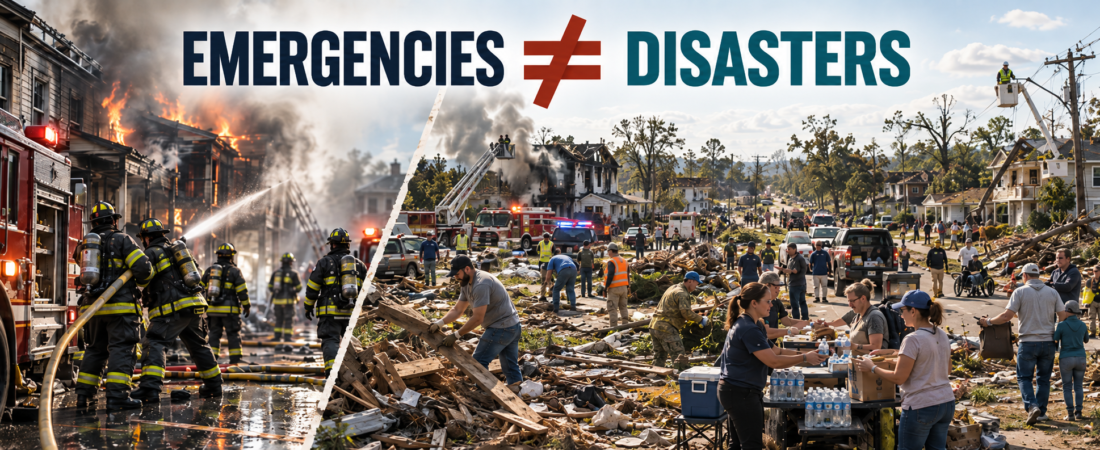
But knowing emergency management is not the same thing as knowing disasters.
If you were never taught how disasters differ from emergencies, how people actually behave under disaster conditions, how communities respond when formal capacity is overwhelmed, or the research that has been documenting these patterns for generations, then there is an entire body of knowledge missing from your professional foundation. And I think that gap is increasingly showing up in our policies, programs, training, and response systems.
So how did we get here? It think it does start with the name.
The United States made a somewhat quirky decision to name the government function responsible for disasters “emergency management.” There is a reasonable logic to government managing emergencies. Emergencies are generally the kinds of events where formal response organizations have the authority and capacity to manage most of the work. Government needs to coordinate its own resources, establish command where appropriate, and manage the emergency before its consequences expand into widespread social disruption.
But then we put disasters under that same umbrella and increasingly moved away from the language of disaster preparedness, and from what much of the rest of the world calls disaster management or disaster risk reduction, fields built on a substantial foundation of disaster science.
Normally, I wouldn’t care this much about terminology. Call the profession whatever you want. But terminology starts to matter when it determines what people are taught.
And that program isn’t an outlier.
There are definitions of emergency management that never actually define an emergency. Instead, they define the work entirely around disasters. A FEMA definition from 2007 that is still commonly used in higher education describes emergency management as “the managerial function charged with creating the framework within which communities reduce vulnerability to hazards and cope with disasters.”
RAND recently released a report attempting to identify and organize “emergency management research.” To my read, it spends an extraordinary amount of effort wrestling with a problem without quite stating what seems like the obvious complication: much of what it is looking for isn’t called emergency management research. It’s called disaster research.
Not to be a mean girl, but I kept thinking, let’s ‘Stop trying to make Fetch happen.’
It just starts to sound silly and we spend a lot of time trying to explain it when it doesn’t make sense. I don’t blame the researchers. They are working within a U.S. institutional and funding environment that increasingly calls all of this emergency management. But, it leads me to further wonder:
Did we collapse the terms because the government job is called emergency manager? If the research follows the title, who follows the research? And are we telling the nonprofits, businesses, faith groups, and neighbors who do most of the disaster work that this knowledge isn’t for them?
And one more: if we rename disaster research “emergency management research,” what happens to actual emergency management research?
We absolutely need research on managing emergencies. Wildland fires, terrorist attacks, plane and train crashes, explosions, hazardous-material incidents, oil spills, and other events can be enormous and devastating without necessarily producing the widespread social disruption that characterizes a disaster. Formal response organizations may still have the authority and capacity to manage the incident, even when doing so requires substantial resources.
That work is incredibly important for government responders and we need to keep getting better at it.
But it isn’t interchangeable with disaster science. The sociology is different. Human behavior can be different. The governance and coordination problems are different. The policy and funding environments are different. Many emergencies do not require the extensive community-wide recovery missions that disasters do. We need serious research, education, and professional development for both.
So why all the relabeling? Are we worried we can’t just say out loud that emergency managers might need to learn disaster science?
Because I think we’d be fine. We can tell emergency managers they need to learn disaster management without renaming everything. It’s a competency, one that’s different from the day-to-day emergencies, but a big part of the job when it comes to preparing for and mitigating against disasters.
So that’s what I’m doing here. Explaining that distinction is one of the reasons I started this blog in the first place, because it matters to outcomes and we can’t keep muddying these waters.
So let me say it plainly: your basic emergency management training in the United States is not enough to equip you to manage disasters.
If your training does not include the foundations of disaster science, the distinction between an emergency and a disaster as something more significant than an increase in scale, how humans behave in disasters, how communities respond, and the research that has accumulated over roughly a century, then your training has not qualified you to manage disasters. It has trained you to manage emergencies.
Those are both important jobs. They are not the same job.
ICS is a perfect example. ICS was designed for on-scene incident management, not as a system for managing an entire disaster. There will be incidents within disasters where ICS is exactly what is needed, sometimes hundreds of them. But we have increasingly treated proficiency in ICS as though it were foundational education in disaster management. It isn’t.
If the majority of your foundational training consists of ICS 100, 200, 700, and 800, followed by 300 and 400 as you advance, you have learned a lot about how the on-scene part of our incident management system is supposed to work. You have not necessarily learned very much about managing disasters.
We misinterpreted NIMS when we built our professional development that way. We took half of an incident management system and increasingly allowed it to become the intellectual foundation for a profession responsible for disasters. But disasters do not behave like larger emergency incidents, no matter how much we shape our doctrine and terminology to make them appear that way. If you are using the same structures and processes to manage a disaster that you use to manage an emergency, you are not managing the disaster. You are managing the parts of it that look like an emergency.
And the consequences of not knowing the difference are not just academic.
In my experience, too many of the people building disaster policies and leading disaster programs have never been taught much about disasters. While we all can get certain experience having worked through them, we can’t see the larger picture that education and training can bring. I can point to multiple times when I raised basic tenets of disaster science in policy and program-development meetings at every level and people reacted like I was proposing navigating by the stars or practicing alternative medicine. Even in my last year at FEMA, I referenced disaster sociology in a meeting where everyone involved should have known what I was talking about, and the looks I received suggested I had introduced something obscure and slightly suspect.
But disaster sociology is the science.
Generations of researchers have repeatedly demonstrated that people rarely panic in disasters and that prosocial behavior is common. People help each other. They improvise solutions when formal systems cannot meet the need. These are not feel-good assumptions about humanity. They are patterns documented across a century of disaster research.
The belief that people predictably panic, become antisocial or selfish, need to be controlled, or cannot be trusted with information is the folklore. When we build policies around those assumptions despite decades of evidence to the contrary, that’s when we’re navigating by the stars.
Yet I continue to see posts and white papers from respected organizations and consulting companies repeat the long-debunked panic myth and use it to support calls for more order, control, and command. That is what happens when we lose the scientific foundation of the field. Rhetoric and familiar assumptions begin to sound just as legitimate as evidence.
We already know so much of the science that could help us build better disaster management. We just aren’t consistently teaching it to the people building and running our disaster systems.
And it shows.
When disasters blow through the assumptions of ordinary emergency management training, people are forced to learn these lessons directly from the disaster itself. That is an extraordinarily expensive way to learn things researchers have been documenting for decades.
The good news is that this is fixable.
Much of this knowledge already exists. In fact, when I looked through U.S. university programs, many of the disaster-focused degree programs still require disaster science, sociology, or related foundational coursework. The science is there. The problem is how inconsistently it makes its way into practitioner education and professional development.
I don’t like using this blog to identify problems without offering solutions, and for this one, I built one.
The Disaster Coordination Lab, launched in beta this week, starts with three short foundational courses: Disaster Fundamentals, People in Disasters, and Communities in Disasters.
I built them because they’re what I wish we had all learned, when I was working in the field and even more when I was working on policy. When we were revising the National Frameworks and FIOPs and Annexes, the people in those rooms should have had this research as common shorthand. We should have been able to discuss disaster sociology, emergence, and the difference between incidents and disasters without first having to establish that these were legitimate areas of study.
We need disaster literacy within the emergency management community.
You don’t need the Lab to get there. Read the textbooks and the research, build it into your internal training, or bring disaster researchers into your organization.
My CEO hat: I hope you join my Disaster Coordination Lab that I built as an easy way to start learning these principles through simple accessible language with opportunities to discuss with others in the community sections. Or we’re happy to consult to help you build your own trainings or disaster systems.
My practitioner hat: however you get there, what matters is that we start expecting people who develop and manage disaster programs to know disaster science.
So if you have influence over an emergency management program, workforce, certification, curriculum, or organization that will be expected to work in disasters, please start building disaster literacy into it. Teach people the incident management system, absolutely. Teach them how to manage emergencies well. Then teach them what changes when the incident becomes a disaster and the government no longer has the capacity or authority to manage most of what is happening.
There is a reason we are consistently struggling through disasters in this country, and we can’t just blame it on funding or the extreme weather. Extreme weather is our job.
Emergency management matters. Disaster management matters. They overlap, but they are not interchangeable.
We can, and should, learn both.
Leave a Reply