
What if we treated emergencies like disasters?
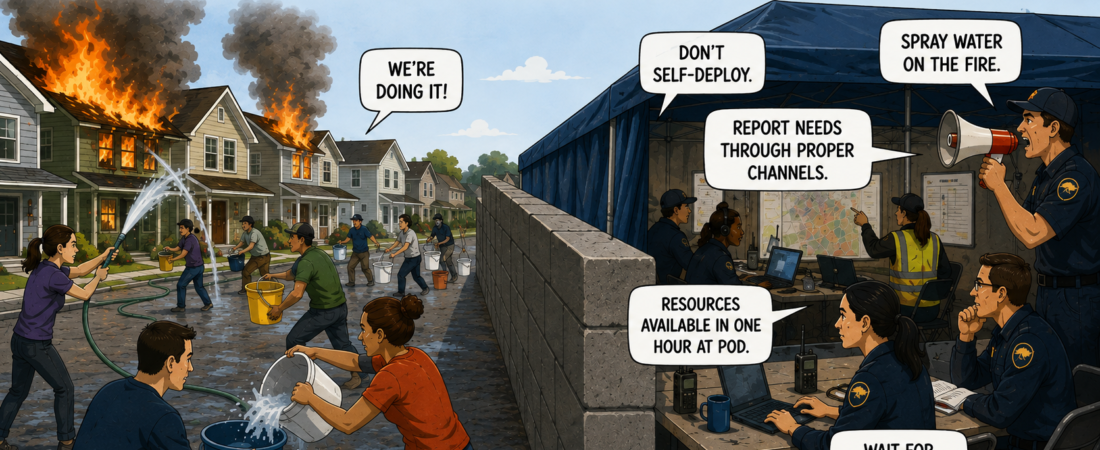
Let’s lighten the mood a little for Disasters are Different blog and take a look at a mirror world to help visualize the theme.
What if we treated emergencies like disasters?
Picture this: a multi-family house fire. A residential neighborhood, homes close together but not attached. A fire has spread to several of them. I’ve been to plenty of these with the Red Cross as a Disaster Action Team member. We get an alert from the fire department and head over to see what the family needs, usually blankets, water, cleanup supplies, sometimes somewhere to stay for a night or two.
The fire department doesn’t need our help fighting the fire. They’re trained for it, equipped for it, and have the authority to run the scene. We stay out of their way. If it grows more complex, more units come in, maybe police or EMS as well. Everyone slots into their role. It works with the Incident Command System (ICS). That’s an emergency being treated like an emergency.
But what if it worked like a disaster?
Imagine the fire started with a gas leak and explosion and has now caught four houses. Everyone gets out safely, and now they turn to the fire itself.
The fire starts at House A on the corner. It jumps to House B next door, then House C, then House D at the end of the row.
Help arrives fast. Engines stream in from three jurisdictions. Police cars pull up. EMS stages nearby. Officials arrive one after another. For a minute, the people standing in their yards with garden hoses and buckets feel something like relief. Help is here. Then they watch it disappear behind a bunker wall.
The responders establish an emergency operations center on the other side of the street, because in our mirror world the job is no longer to fight the fire directly but to coordinate everyone else fighting it. They need somewhere to see the whole picture, coordinate incoming units, keep track of resources, and stay safe while they do it. But from the yards, all anyone can see is a structure going up, people going in, and very few of them coming back out.
Inside, they aren’t sitting still. They’re working hard to get information out. A megaphone crackles. “SPRAY WATER ON THE—” and it cuts out. Someone adjusts something and tries again. Half the message carries on the wind. The rest disappears under chainsaws, generators, sirens, and the fire itself.
The people behind the wall can see the confusion. Someone stops mid-stride. Someone looks around trying to figure out whether the message was meant for them. So another announcement goes out, louder this time, hoping enough of it lands. It doesn’t, not really. And the people in the EOC can’t leave every few minutes to deliver instructions house by house. That’s not what the post is designed to do.
Someone from House B has had enough of guessing. He walks up to the wall and asks what is the best way to tackle this fire and how to get more equipment, for his house, right now. A woman in a vest tells him they are still working through the planning process and gathering the information they need before they can issue clearer guidance. She is kind and empathetic, trying not to show her frustration that she can’t do more. She is trying to do exactly what the system asks her to do. But he walks back to House B with the same amount of information he left with, and less water in his bucket for the time he spent asking.
Meanwhile, neighbors from other streets begin showing up to help. A local rec league team heard what was happening and arrives together. The neighborhood watch captain knows most of them, so she starts organizing people in real time, sending a few to House A, more to House C, and redirecting others as conditions change.
Someone behind the wall notices. This is great. Community capacity. They call the neighborhood watch captain over and explain that they need a representative inside the EOC so the volunteers can be integrated into incident operations.
She understands the logic. Someone should coordinate with the responders. The volunteers should not be working at cross-purposes or wandering into unsafe areas. But every minute she spends behind the wall is a minute she is no longer outside directly helping. It makes perfect sense from where the EOC is standing. From where the houses are standing, the person who had been organizing help in real time has now also disappeared behind the wall.
A little later, word begins circulating that extra hoses, buckets, and protective equipment will be available at a Point of Distribution six blocks away, beginning in one hour, for a two-hour window. The message passes from house to house, getting slightly more garbled each time. Eventually the owner of House C hears about it. He looks at his burning house, then at the six-block walk to the distribution point. He hands his hose to a neighbor and goes. By the time he gets back, he has another hose. His garage is gone.
Food and bottled water are available at the end of the street. Everyone agrees that’s helpful. The problem is that the people who most need them are holding hoses and don’t want to take the time to stop.
Inside the EOC, the information picture is getting much better. A map now shows which homes are burning, which are threatened, which have requested assistance, and where resources have been assigned. There is a dashboard. The dashboard looks excellent. Unfortunately, the landscaping contractor who lives two streets over and has just arrived with a 500-gallon water tank isn’t on it, because nobody has reported him through the right channel yet.
He starts toward the houses anyway. Someone calls him over so they can figure out who he is, what he has, and how to incorporate him safely. Again, reasonable. Again, time.
By now, more responders have arrived to coordinate the responders who are coordinating the residents fighting the fire. There are planning meetings, resource meetings, briefings, leadership calls, and handoffs between operational periods. More people are needed to keep track of all the people who have arrived. The people in the EOC are working incredibly hard and increasingly frustrated that all of their activity isn’t translating into visible progress outside. So are the residents. The houses are still burning.
Turn the Mirror Back Around
Now I know this is ridiculous. We would never organize a house fire this way because we understand where the capacity to solve the problem resides. Firefighters have the training, equipment, authority, and ability to act directly on the hazard, so we organize the response around enabling them to do exactly that.
A disaster reverses that relationship.
Once the work required to manage the consequences dwarfs the work required to manage the hazard itself, the workforce changes. Firefighters can extinguish the fire. They cannot make thousands of households find somewhere to live, reopen businesses, restore supply chains, navigate insurance, care for displaced family members, repair private property, find food, or make all the other decisions required to stabilize their lives.
That work is distributed because the consequences are distributed.
A command-and-control model works when trained responders can act directly on the problem. More trained people, better information, more equipment, and clearer direction can directly change the outcome. That’s how a firefight works.
But disaster management is largely about consequences, and no incident commander can command those consequences away. That’s why adding more people to an EOC does not necessarily add more capacity to change the disaster. It may improve the formal response system’s ability to understand and coordinate its own work, but most of the actions that determine the eventual outcome still happen somewhere else.
Using emergency models where they don’t fit creates logic problems across every phase of disaster work. We lean toward government solutions. We build around the myth that somewhere in a disaster there must be an incident-commander equivalent: some entity with enough information and authority to change the whole situation.
Look at the structure of an EOC, an Incident Action Plan, even a briefing schedule. So much of it drives toward the idea that if we gather the right information, find the right analysis, identify the right signal in the data, it will reach someone with the authority to take the action that changes the situation. Sometimes it does. But in a disaster, most of the actions required to change the overall outcome are not available to any one person in that room. They are distributed across governments, utilities, businesses, nonprofits, neighborhoods, households, property owners, and individual people.
It’s easiest to see this during response because response is easiest to picture. But the same instinct follows us across the disaster cycle. We build preparedness around the plans and exercises formal systems need and then invite the community into them. We build recovery structures after the event and ask people to navigate them rather than investing beforehand in the capacity communities will need to recover. It’s in the way we talk about government aid needing to be funneled (“locally executed, state managed, federally supported”). We often move information, resources, and decisions inward before trying to push their benefits back out.
Each choice can make perfect sense from inside a government agency or large response organization. Taken together, though, they reveal where we’ve placed the center of the system.
The information is being concentrated while the ability to act remains distributed.
That’s why we need to build disaster systems around coordination, not only command. Incident command works when responders can act directly on the problem. Coordination is what lets everyone else act on the distributed consequences of a disaster.
The problem isn’t that people are failing to make the system work. It’s that we’re asking an emergency-response system to do disaster-management work it was never designed to do.
Leave a Reply