Partner vs. Parent: The Donations Dilemma
Craig Fugate recently wrote about the distinction between treating disaster survivors as victims or as partners, and how well-intentioned systems can inadvertently take away the very agency people need to recover. One line in particular stuck with me: “Recovery works best when people are treated as capable adults—survivors who can make decisions, take action, and rebuild on their own terms.”
It got me thinking about other ways our messaging might be taking agency away from communities. One of the most visible examples is how we talk about donations.
What We Tell People
If you’ve spent any time in emergency management, you’ve heard it or probably said it:
“Don’t send stuff. Just send money.”
We call unsolicited donated goods “the second disaster.” We actively discourage people from collecting and sending material aid. And not without reason.
I personally have dealt with more donated materials than I ever care to remember. On one memorable occasion, after hours of unloading a trailer full of donations, my colleagues gifted me a single shoe from a donation pile as a memento of our efforts, and as a reminder that I failed to find a way to say no when an elected official insisted we take the donations they had collected.
As practitioners, we know the pain of collecting, sorting, warehousing, and often finding alternative uses for donated items, or, let’s be honest, sometimes arranging waste collection. We’ve built preparedness campaigns and talking points around this problem, frequently pointing to the teddy bears after Sandy Hook as a cautionary tale. We tell people not to collect and send donated materials.
But mostly what we really mean is: don’t give them to us.
What Communities Do Anyway
People giving donations that don’t quite match the need is an age-old problem, even memorialized in the movie Clueless. But that’s because the practice of collecting goods to help people in need is as old as time. It is an integral part of community response, both in disasters and in everyday life, and a critical resource in recovery.
I was reminded of this after Hurricanes Helene and Milton hit Florida, watching my high school class group chat organize donations from Miami to a school community in Tampa. When I first saw where it was headed, with one person asking the 200-plus-member chat for materials, I almost jumped in to say, “No, don’t do it.” I’m very glad I didn’t.
The ask was specific. There was back-and-forth about the need. They managed delivery themselves and got items directly to a community group in need. Direct. Relationship-based. Immediate. No paperwork involved.
That’s community mutual aid. It happens whether we endorse it or not. And I think this is what we really mean when we say that all disasters are local.
The Gap We Don’t Talk About
Here’s something we don’t often say out loud: the government does not actually replace what we are discouraging.
FEMA does not give out clothes, furniture, or household goods. In a large disaster, most responding organizations or agencies don’t either, at least not in the immediate aftermath. We do provide money intended to cover these needs, but we know that money almost never stretches that far.
These items may not always be life‑or‑death, but they sit squarely in the space of dignity and livability. They matter to survivors, especially those on a faster recovery timeline than the formal response. I’ve worked many cases in different roles trying to solve this gap, families needing basic items to make a home, or even a temporary space, livable, with no clear way to access those items through official channels.
Eventually, long-term recovery groups form and may begin to fill these needs. But that can take months and still be resource constrained.
So what happens in the meantime? Are we creating a service gap by discouraging something that has always been part of disaster response, without being able to replace it in our current structure?
Disasters Are Different
Maybe the issue is that our messaging does not distinguish between what works in routine emergencies and what works in large-scale disasters.
I’ve seen donation processes work beautifully after small, localized events, especially after single- or multi-family home fires. I am often amazed by the generosity that shows up in those moments.
But in disasters, our systems are, by definition, overwhelmed. Needs are massive and varied. Formal structures must prioritize the most critical needs for the most vulnerable populations. And even then, we struggle.
We’ve also let lapse many of the tools we once used to manage these gaps. Like so much of the systems and processes that were around when I started in disaster, the Coordinated Assistance Network (CAN) is one way that we used to work together to provide resources. As flawed as they were and outdated as the technology would be now, it seems like we’ve retreated from that territory and stopped attempting to fill the space.
Given the limitations of the formal response and recovery apparatus, can we afford to discourage this community-to-community or individual-to-individual mutual aid?
Questions Worth Asking
If we are telling communities “don’t participate in this form of mutual aid” without being honest about our limitations, are we acting more like parents than partners?
And if disasters are fundamentally community events, what does it mean when our messaging pushes communities away from response roles they have always filled?
This isn’t the only place where our messaging may be creating distance between communities and response. More on that in the coming weeks as I discuss CERT, self-deploying, and the problem with Whole Community.
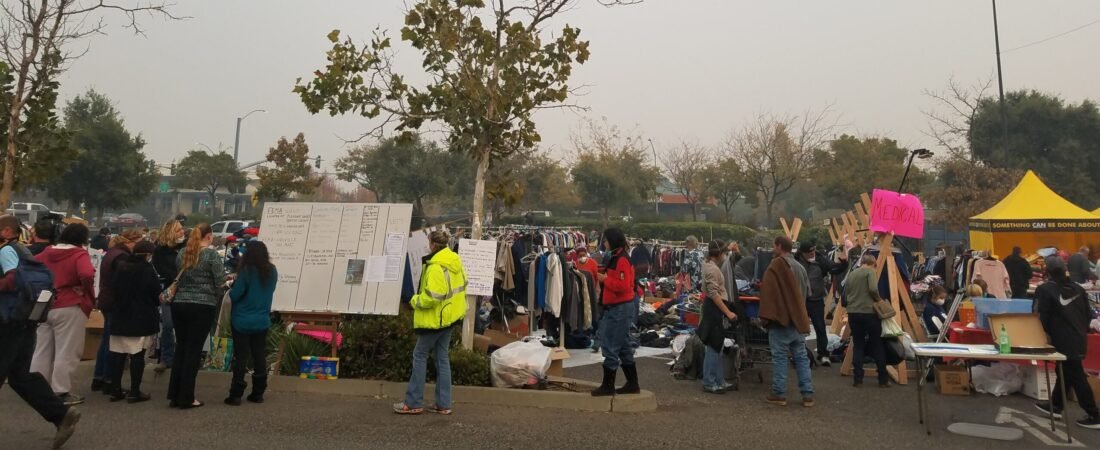
Photo – Camp Fire 11/14/2018 – if memory serves, I took this at the Walmart parking lot in Chico, CA.